Welcome to Metallurgical Hengtai (Tianjin)Technology Co.,Ltd
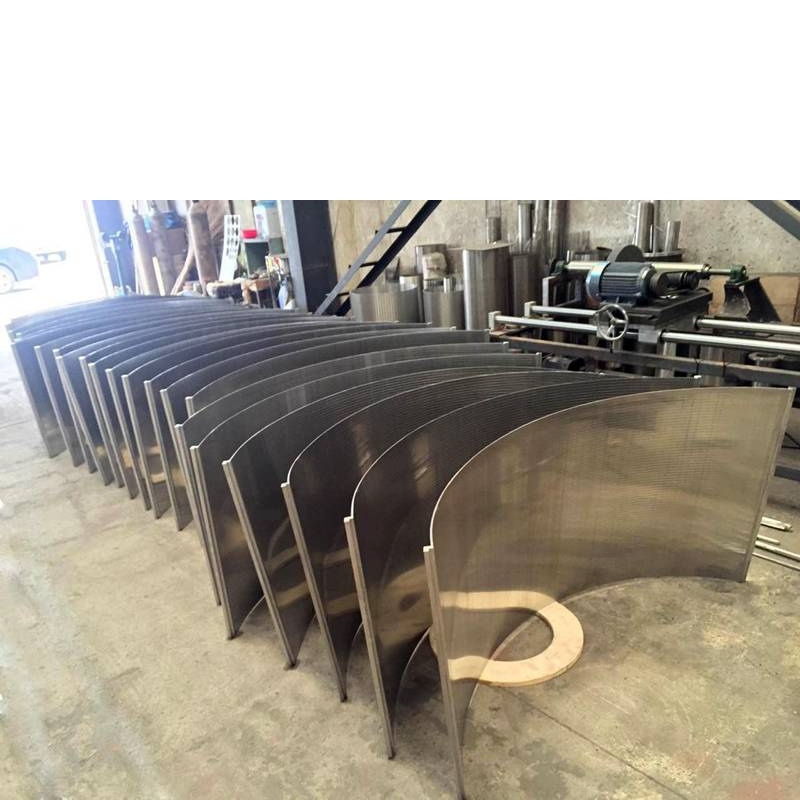
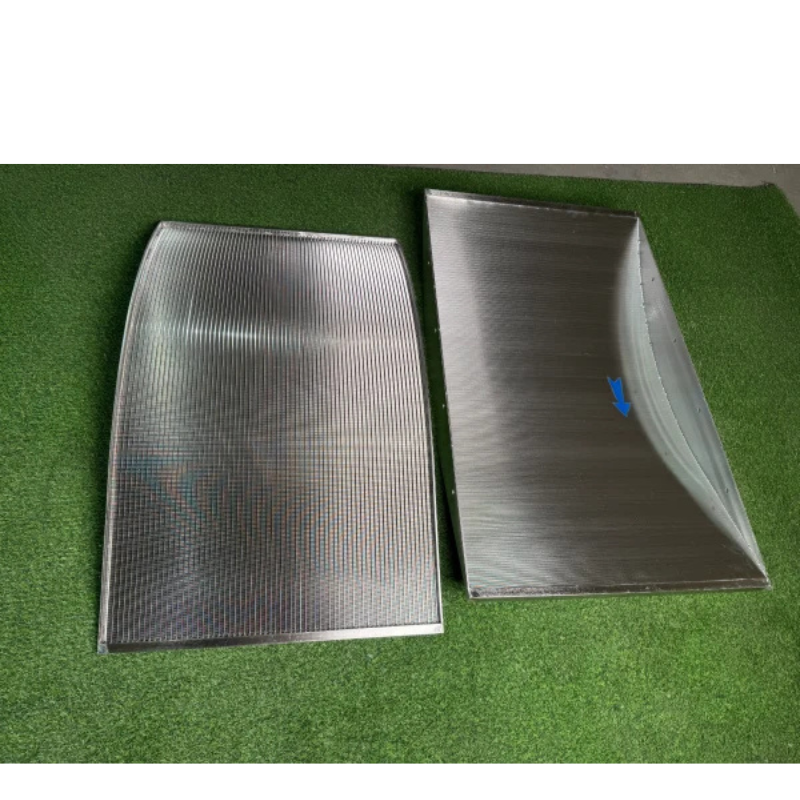
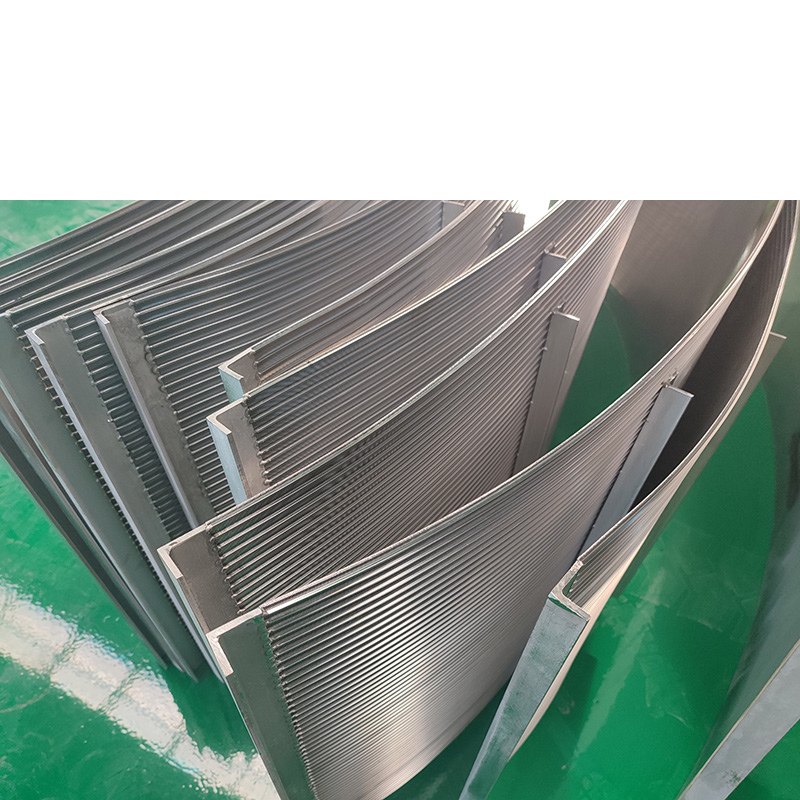
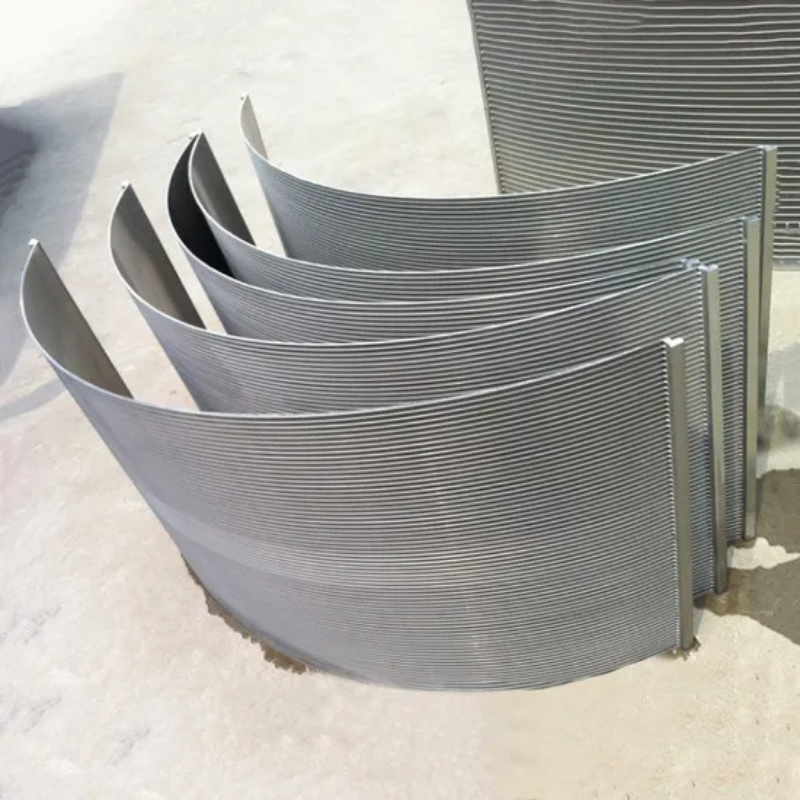
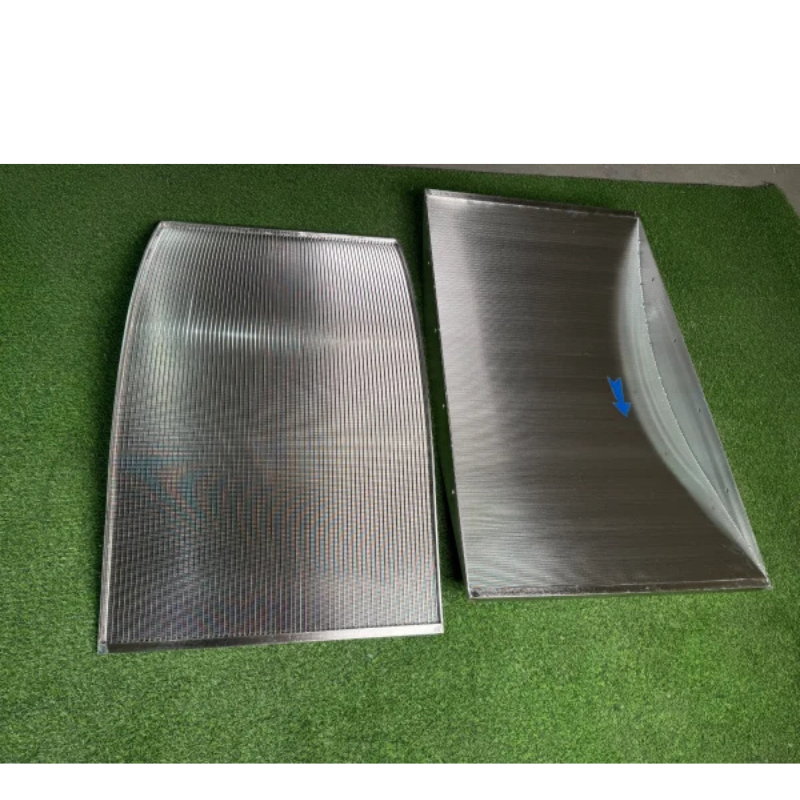
Sieve Bend / Wedge Wire Curved
Wedge Wire Screens — The Slot Widens Behind the Opening
Wedge wire screens built by resistance-welding V-profile wire to support rods at exact intervals — flat panels, curved arc panels and sieve bends, cylinders, baskets and flanged segments in 304 and 316L.
Wedge wire screens do not clog as easily as mesh or perforated plate for one reason, and it is geometric rather than a coating or a surface treatment. The profile wire is V-shaped in cross-section: the wide flat face sits on the working side, and the wire tapers to a narrow apex behind it. That means each slot is narrowest exactly at the screening surface and widens immediately behind it — so a particle that enters the opening has somewhere to go instead of wedging, and a slot that starts to pass flow keeps passing it. Nothing about that advantage wears off, because there is nothing applied to wear.
The specification trap in this product is that slot size alone does not define a screen. Two screens can both be described as "0.5 mm slot" and behave completely differently, because the open area, the flow capacity and the stiffness are set by the profile wire dimensions and the support rod layout together with the slot. We ask for all three, and we quote all three. The second thing we hold is slot uniformity across the whole panel, not at one sample point. On a curved arc panel or a basket, the wires have to be evenly tensioned and welded so that the slot stays constant from one end of the arc to the other — if the slot opens across the arc, the cut point changes across the panel, and part of your screen passes material it was bought to reject. And underneath all of it sits the joint that actually decides quality: every profile wire is resistance-welded to every support rod, which on a full arc panel means thousands of welds. A failed weld is not a cosmetic defect — it releases a wire, widens a slot locally, and can put a fragment of stainless into your product stream.
Specification at a glance
| Types | Flat panels,curved/arc panels,sieve bends,cylinders,baskets,flanged segments |
| Profile wire | V-shaped (wedge)profile,flat working face;dimensions to your specification |
| Slot size | [0.025]-[20.0]mm,to your cut point |
| Support rod | Resistance-welded to profile wires;spacing [25]-[300]mm,to your specification |
| Slot tolerance | Held across the full panel or arc;slot recorded on the inspection sheet |
| Open area | Determined by the slot,profile width and support rod pitch—quoted as a set,never as slot size alone |
| Geometry | Flat;curved to your radius;cylindrical and conical;drilled flanges and support rings to your drawing |
| Materials | Stainless 304,316L,duplex—matched to your fluid,temperature and corrosion duty |
| Fabricated assemblies | Screens mounted in housings,with lids,handles and fixings to your drawing |
| Documents | EN 102043.1 MTC,slot gauge and uniformity record,dimensional report,weld inspection record,packing list,B/L,certificate of origin |
Why buyers specify their screens here
Slot held across the panel, not at one point. Uniformity is measured and recorded along the arc, so the cut point you qualified is the cut point the whole screen delivers.
The weld is inspected and documented. On a wedge wire screen the wire-to-rod weld is the quality-determining joint, with thousands per panel — treated as a critical feature, not an assumed one.
Profile and support rod quoted together with the slot. Open area, flow capacity and stiffness are defined as a set, so a "0.5 mm slot" enquiry comes back as a screen that actually performs.
Curved panels and baskets made to your geometry. Radius, arc length, flange pattern and bolt holes cut to your drawing or a sample screen.
Send your slot size, profile wire dimensions, support rod pitch, panel or basket geometry, radius and flange drawing, material and quantity. We will confirm the slot tolerance we can hold, quote FOB [Tianjin] and give you a lead time — usually within [24] hours.